
Introduction
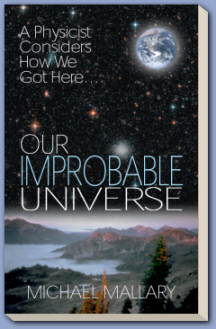
Our Improbable Universe asserts that this universe is of inherent value whether or not it was created. The evolution of energy into matter, matter into life, life into mind, and mind into collective mind, is scientifically traced from the earliest moments of the Big Bang up to the present. This picture shows that a large number of physical phenomena had to be almost exactly as they are in order for us to have evolved out of the raw energy of the Big Bang. If the life begetting substructure of our universes arose from a random process, then our fertile universe is a rare gem amongst an uncountable number of dead ones. If its physical laws were micro-engineered by a creator, the accomplishment is awe inspiring. Either way, this incredible universe, and the life it has spawned, should be cherished. We are inherently part of an ongoing creative process that is majestic in and of itself.
Chapter 1: Fourteen Stepping Stones
The energy of the Big Bang has spontaneously turned into people who can find joy in being, no inquisitive mind can ignore this fact. How did it happen? Why did it happen? How might the sequence of events have gone differently and failed to produce life? Is the universe the result of deliberate design? Was cosmic evolution a random chain of events? If so, what were the odds? Though it is impossible to provide complete answers, these questions cry out for our best effort attempt using all we know today.
In the spirit of this curiosity, all human cultures have generated creation myths. These myths have provided insight into the origins and workings of the beautiful and capricious reality that has spawned our existence. Modern science comprising a vast body of observations and theories has greatly enhanced our understanding of our origins and fate. Through the scientific mind's eye, it is possible to see back into the history of the cosmos, and as we look in detail, we see an ever-lengthening list of characteristics that had to be just the way they were for intelligent life to have evolved. In other words, our extremely creative universe is also extremely improbable. Our Improbable Universe elucidates this assertion and explores some of its philosophical implications.
To comprehend how improbable it is that this particular physical reality with its biological riches, came into being, we have to follow the story of creation from the beginning to the present. About fourteen billion years ago our universe exploded from a tiny point, a moment called the Big Bang. Though many of its details are still controversial, very few scientists dispute that the Big Bang happened. In the twentieth century, astronomers have established that all of the galaxies beyond our local cluster are rushing away from us. The most distant ones are moving away at nearly the speed of light. By mentally reversing this motion, one sees that all of the matter in this universe must have arisen from a single point in the distant past.
As scientific knowledge expands, consensus develops about the detailed history of the Big Bang. Currently the greatest controversy involves the details of what happened when the entire visible universe was smaller than a grapefruit, i.e. this is when the great-grandparents of matter were created out of the unleashed energy. This early matter later coalesced into the protons, neutrons and electrons that are the bricks and mortar of the atomic level of reality. The fact that any matter was left after only three minutes is actually one of the unsolved mysteries of science.
It is astounding that we live in a universe in which particles can spontaneously organize into people and other incredible beings. Adding to the wonder is the fact that this depends on an exact delicate physical structure that resulted from the Big Bang. Had this structure been slightly different in any of a large number of ways, the result would be a sterile universe. There would be no people, trees, or even bacteria.
In the last several hundred years, science has provided new ways to appreciate the beauty and complexity of existence. Unfortunately, a relatively small number of people have access to this way of seeing. Even practitioners of the scientific arts in many cases do not take a broad enough view to see the whole picture. Because this life-enabling sub-structure is not well understood by most people, it is often taken for granted. Life, taken for granted, is abused. The wanton destruction of our ecosystem is one example. The degradation of the human spirit in mass society is another. Possessed only with ignorance, we are as bulls in a china shop. Through knowledge of the universe, we can learn to love and respect humanity and our fragile biosphere.
In this book, I hope to provide a glance into this universe upon which life is based. This view will show that many balancing acts are taking place one on top of another, to produce us and all that we see. The phenomena that led this universe to produce galaxies, stars, and planets are some of the "stepping stones" on the path to our emergence. For example, just a slight change in the amount of energy and matter produced by the Big Bang would have resulted in a universe without galaxies or stars let alone people.
In addition to the amount of mass-energy, there are at least thirteen other properties of our universe that were required to be the way they were for the Big Bang to have produced anything like us. One doesn't need to understand the science of these properties completely in order to appreciate how critical they are to our existence. Much of the science described here even baffles expert physicists. There are intricate dynamics beyond present human comprehension. The tip of the iceberg that modern science can see is incredible, but importantly, it hints at a deeper reality that is even more astounding. Here is a quick overview of the fourteen stepping stones; more explanation of the importance of these phenomena is provided in later chapters.
Fourteen Stepping Stones
1) Six Kinds of Quarks:
The mass of your body is 99.95% nuclear matter, the clumped neutrons and protons of the nuclei of your atoms. Each particle is a clump of two different kinds of quark particles. In order for any of this mass to have emerged from the Big Bang, the universe had to be capable of producing at least six different kinds of quarks. Why? Because six quark varieties allows for a subtle asymmetry between the behavior of matter and antimatter. This lack of perfect symmetry is called Charge Conjugation-Parity (CP) symmetry violation, put more simply as CP Asymmetry.
2) CP Asymmetry and more:
Though six kinds of quarks allows for a CP asymmetry, it does not require it. Without CP asymmetry, the Big Bang would have produced exactly the same amount of matter and antimatter. Then after several minutes, the matter and antimatter would annihilate each other leaving nothing but an expanding ball of light and the nearly inert particles called neutrinos. This would have been the sum total of the history of the universe. The future would contain nothing new after the first few minutes. But because of CP asymmetry, thanks for there being six quarks, for every billion particles of antimatter created in the Big Bang, a billion plus one particles of matter came into existence. All matter that we see today is that extra one part-per-billion left after an incomprehensibly huge conflagration of mutual annihilation.
But in addition to CP asymmetry the production of a surplus of matter depended on two more conditions. In the early universe there had to be an era when energy and matter were in a state of non-equilibrium and there had to be a mechanism for transmuting quarks and antielectrons into each other (see Chapter 2). .
3) Just Enough Energy and Matter to Matter:
When the part of our universe that we can now see was the size of a grapefruit, its density of mass and energy was just right relative to its rate of expansion: a difference of one part in a trillion trillion trillion trillion trillion would have precluded our existence. If the density had been higher, the Big Crunch, a contraction of everything, would have occurred too soon. The Big Bang would have been the Little Pop. Had the density been less than it was by the tiniest of fractions, the era of star formation would never have come to pass. Gravity would have been unable to overcome the outward rush, and the universe would have become a diffuse ball of isolated atoms, with no potential for congregating into stars. An explanation for this paradoxically precise amount of mass-energy density is one of the great triumphs of the Inflationary Model [1] of the Big Bang.
4) Just Enough Lumpiness:
There had to be a slight amount of lumpiness in an otherwise smooth distribution of matter to form the seeds for galaxy formation. Some regions of space had to have slightly more matter than others. If the universe had been too smooth in relation to the expansion rate, then matter would not have pulled together to form stars. On the other hand, if the early universe had been too lumpy, then it would have become a very violent place. Gigantic black holes would have formed everywhere and gobbled up everything.
5) Four Forces:
The complex behavior of matter is prescribed by four different forces and the existence and relative strengths of these forces have been essential to creating a fertile universe. The most familiar is gravity, the effects of which are only visible on a scale much larger than our bodies. Importantly, it holds the Earth to its orbit around the sun. The raw energy of the Big Bang, from which all matter and energy emerged, came from the gravitational force. The coalescing of matter into planets and stars depends upon gravity.
The next most familiar force is electromagnetism. It makes magnets stick to refrigerators and lint stick to your clothes. At an atomic level, it causes electrons to orbit the nuclei of atoms. This force also allows atoms to stick together to make the thirty thousand complex proteins that our life depends upon. Our very thoughts are carried by neural impulses that are a complex mix of chemistry and electricity.
The last two forces are called "strong" and "weak." They are much less familiar to us because they operate only at sub-atomic distances. The strong force (also known as the nuclear force) glues protons and neutrons together to make complex nuclei. The weak force conspires with the strong to allow stars to burn hydrogen in a slow and steady way for billions of years. It changes protons into neutrons so that complex nuclei like carbon and oxygen can be built up. Without the weak force, giant old stars would not blow up and disgorge into space these important complex atoms, without which life would not stand a chance.
Life would be impossible without any one of these four forces. Each could be considered a stepping stone to life in its own right. It is only a matter of bookkeeping convenience to group them as one very important stepping stone.
6) Protons Don't Quite Stick:
The existence of long-lived stable stars like the Sun depends on the relative strengths of all of the forces being just right. In particular, the nuclear force between two protons must be almost exactly what it is. If it were stronger by one half percent, two protons would stick together permanently to form a helium 2 nucleus and throw off a lot of radiation. Fortunately, this does not quite happen. If it did, hydrogen would burn into helium at such a high rate that all stars would burn out in less a hundred million years. In this universe, helium 2 nuclei hold together just long enough (i.e. 0.00000000000001 of a second) for our sun to burn hydrogen slowly and steadily, meaning it will go on for another four billion years. On the other hand, if the nuclear force were several percent weaker than it is, hydrogen burning would occur only in giant short-lived stars. In either case, there would not be enough time for anything complex to evolve. Though life might have been possible without stable stars, it would have been much less probable. If life's only stable habitats were chemical-rich hot springs, deep in the crust of the earth, then it is very doubtful that it could ever evolve from the primitive bacteria that live there into anything like us.
7) Helium Nuclei Don't Quite Stick:
Two helium nuclei stick together for even less time than two protons. This is good. If they stuck more readily, helium would burn into carbon at such a high rate that stars would burn quickly and then blow themselves to smithereens. If they did not stick at all, helium would not burn into carbon and the other elements of life. Had this been the case, the only complex atoms remaining would have been the tiny residue of lithium from the age of nuclear synthesis that ended three minutes after the Big Bang.
8) Excited Carbon and Calm Oxygen:
Carbon has an excited state of energy [2] that is just right to be reached when one more helium nuclei joins two others that are temporarily stuck on each other. This excitement in carbon allows it to hold together instead of breaking up into three helium nuclei most of the time. This enhances the rate of carbon production enough to stay ahead of its conversion into oxygen. Without this state at the right energy value, there would be very little carbon in the universe. The absence of a corresponding excited state in the oxygen nucleus is also fortunate in this regard. One could argue that life could evolve from a chemical system that did not include carbon, but carbon is extraordinarily suited to life's complex chemistry.
9) Big Stars Blow Up:
About five billion years ago, in this region of the Milky Way, the vast majority of Earth's matter blew out of a giant star in a supernova explosion. As the song says "We are star dust." That stars explode the way they do at the end of their lives depends critically on many aspects of physics. These explosions spew into space complex elements that are cooked in the star's interiors, and these elements are the ingredients of the kind of rocky planet, with land, sea and sky, that we know and love.
10) Chunky Neutrons:
Heavyweight neutrons are required for long-lived stars. If the mass of a neutron were less than that of a proton plus an electron, then the Big Bang would have produced a profusion of very heavy elements. There would be no lack of chemicals in that alternate universe. However, all hydrogen would be in a form that would burn rapidly in stars. Therefore all stars would be short-lived. The fact that neutrons are heavier depends on details of subnuclear physics. If they were 0.1 % lighter than they are, there would be no long-lived stars in our universe.
11) Long Live the Proton:
The most advanced theories of elementary particles predict that all protons and neutrons will eventually decay making life impossible. But fortunately, the decay of protons is so slow that it has not yet been observed. Nevertheless, we should not take long-lived matter for granted. Freeman Dyson has proposed that it will be the ultimate test of the adaptability of our species to cope with this eventuality. He speculates that our decedents might transform their material being from a dependence on atoms of ordinary matter to one based on electron-antielectron atoms. Whatever the likelihood of this wild idea, we have some time to get our act together. Experimental results indicate that this problem is at least ten billion trillion trillion years in the future.
12) 3D Reality:
For life, three is the magic number where spatial dimensions are concerned. These are Up/down, forward/backward, and left/right. To start with, three or less spatial dimensions are required to produce stable planetary orbits. If there were a fourth spatial dimension, the orbits of planets would not be stable in the manner of the Earth's orbit around the sun. In a universe that had four or more dimensions, orbits would be metastable. They would be like a pencil standing on its point. The slightest disturbance will make the pencil fall one way or the other. In a four-dimensional universe, the impact of a meteor on the dark side of a planet would cause it to gradually spiral in towards its star, where it would burn up. This is because the effect of gravity would grow in strength too rapidly, as distance decreased, for centrifugal force to prevent the planet's capture. Conversely, a meteor impact on the bright side of the planet would cause it to spiral out of its orbit. The strength of gravity would drop too rapidly to prevent escape into the dark and chill of deep space.
Theoretically, in a two-dimensional universe like the surface of this page, stable orbits can occur. However, complex neural networks, like our brains, would be impossible. The thousands of connections that each of our brain's neurons makes to each other would be blocked if the neural fibers (wires) could not cross over each other. Imagine a brain that consisted of neurons confined to the surface of this page. In order for a neural fiber to cross over another, to form a remote connection, it must lift off the page's surface. It must exploit a third dimension (up/down). The pulsations of a jellyfish-like creature would be its highest form of intellectual achievement. It is also unlikely that anything resembling the complex chemistry of life could occur in only two dimensions. The ability of carbon atoms to form bonds in multiple directions is crucial to many of life's processes. Therefore, two-dimensional universes are unlikely to be fertile either.
13) Wavy Matter:
The wave nature of matter, described by quantum mechanics, is necessary for any universe that is more than a collection of black holes. Waves resist being squeezed into small volumes by forces and therefore resist collapse. The smaller the space that a quantum wave occupies, the higher the energy it has and the more it pushes out. This results in a pressure that resists compression.. In the classical physics of particles (e.g. billiard balls), there is no such pressure. Classical matter would readily gravitationally collapse into black holes. In addition, waves are fundamental to the workings of matter and energy. None of the physical details described above would be anything like the same without this foundation. Our incredible reality is the interplay of countless shimmering waves.
14) Reclusive Particles:
The tendency for atoms to form complex chemical bonds results from the Pauli Exclusion Principle which states that two electrons cannot be in the same quantum state (e.g. the same place and velocity) at the same time. Electrons, protons, and neutrons are loners and not groupies. (The exclusion principle depends in turn on the integrity of four other fundamental principles of physics that will be described later). In fact, all stable particles with mass obey the exclusion principle. Without this behavior there would be no complex chemical bonds, there would be no isolated particles as such. There would only be metals. Without exclusivity, groups of particles would congregate in ultra-dense gravitationally bonded clusters. As such, they would easily collapse into black holes and that would be that.
The above recipe of fourteen essential ingredients for a universe in which sentient beings can evolve is undoubtedly incomplete. As science advances the list will lengthen. Here are some other condition without which life would have been hard-pressed to emerge, if it could have been possible at all.
Long-lived Natural Radioactivity:
Long-lived radioactive elements like potassium40, uranium and thorium are needed for the renewal of carbon dioxide in our atmosphere in the distant future. The decay of these elements in the Earth keeps volcanoes active by replenishing the primordial heat of the earth. Volcanoes in turn replenish carbon dioxide in the atmosphere, an element without which carbon-based life would be in big trouble.
Vast Stellar Spacings:
We should thank the stars for keeping their distance, for if stars were more closely packed, near collisions would be more frequent. These close encounters would destroy planetary systems by flinging the planets into deep space or into eccentric orbits with highly variable climates. This happens in the densely packed centers of galaxies and in globular clusters of stars. Fortunately for us, it does not happen often in our outer galactic region.
Ice Floats:
Most solids sink in a pool of their liquid, but oddly ice floats in water. This is very good for waterbased life. Chilly oceans such as on Europa (a moon of Jupiter) develop a thick crust of ice that insulates them from the deep freeze of space. Under the ice, life stands a chance. Recent studies indicate that on Earth global freeze-overs have happened many times[3]. If water froze from the bottom up instead of from the top down, life here would be a great deal more primitive than it is. Only creatures that could ride out being frozen solid would survive.
This list of non-essential ingredients could go on much longer. Many are specific to evolution on Earth [4]. But the list of fourteen essentials already demonstrates that this universe is astonishingly suitable for life. Truly, the uncanny coincidence of all these factors seems to give the appearance of deliberate design. In the nineteenth century, William Paley saw the skill of "the Master Watchmaker" in all of the wonders of nature that were apparent then. Today we know more of the tightly organized mechanics of the universe, and have ever more to wonder at.
But a deistic hypothesis is not the only explanation for a fine-tuned universe that has produced life. There are many scientists who propose that this beneficent structure has been determined by a random unknowing process. While a fertile universe is improbable, there might be a huge number of universes, each with its own physical laws, being produced by a random process making the emergence of one universe with all "the right stuff" more likely. Prior to current, inflationary theories of the Big Bang, the Nobel laureate John Wheeler proposed that the universe may pass through many cycles of Big Bang explosions followed by Big Crunch contractions. In each cycle, the newborn universe might have an entirely new physical substructure. After a trillion trillion cycles a fertile universe with sentient beings could result.
Inflationary models hypothesize that a large numbers of universes are being spontaneously created in parallel within a gigantic metauniverse. The metauniverse is like a huge frothing sea with in which each universe is like a bubble of steam rising and expanding from the bottom of a hot pan of boiling water. Just as the Milky Way galaxy is one galaxy in our observable bubble of trillions of galaxies, our observable universe may be only one in a larger metauniverse that contains trillions of universes. They may be like our own or different from it in any or all of the fourteen respects discussed above. If they are different, the vast majority are probably also sterile. In both (cyclic or parallel) approaches it is possible to imagine that at least one universe in a trillion trillion had just the right properties for life to evolve.
In a universe that produced observers, they would marvel at the apparent providence of its physics. It would seem to have been designed, even if it hadn't been. This particular interpretation of the apparent compositional wholeness or design of the universe is known as the anthropic principle. Any universe that produces witnesses would appear to be designed, in part because the botched universes are not observable to the inhabitants of the successful ones. We can view them only in the mind's eye.
A statistically-based hypothesis for generating fertile universes brings to mind the old "monkeys and Shakespeare" game. Imagine a huge number of monkeys banging away at typewriters. The goal is for them to generate a work of Shakespeare through sheer random persistence. In a trillion trillion attempts they can get "to be or not to be." If each attempt requires three monkey minutes (the time it took the Big Bang to create the nuclei of some simple atoms), and there are a billion monkeys, then it will take a billion years to get this phrase. If only this successful attempt had an audience then the huge number of failures would only matter to the monkeys (and the monkey managers who had to keep them at it for a billion years). In this hypothesis, the monkeys are a mindless random process that is not concerned with speed and efficiency. Yet when all is said and done, an observer might still find "to be or not to be" in the babble and declare it to be the work of God.
So here is where the battle line is drawn in the debate over whether or not the universe was created. If a phenomenon is perceived to be fine tuned for life at the level of one part in a hundred, then a proponent of the anthropic principle simply proposes a hundred times more randomly generated universes to make the additional requirement statistically feasible. The compound odds against getting a life-friendly universe keeps mounting. But there is no shortage of bubble generating points of instability in the meta-universe like the one from which our universe popped into existence. Alternately, in a pulsating universe, it is merely a matter of waiting out a hundred times more cycles of expansion and collapse before a "hospitable" universe arises. If there are no witnesses during the sterile cycles, then the process wouldn't seem too long. Even a creator, with enough patience, might choose, or have no choice but, to create in this fashion.
It would appear to be impossible to prove the presence of the hand of the Master Watchmaker from the intricacy of the watch. However, one might hope to find evidence for the artist's signature on the canvas. Or perhaps a built-in bias that reflected a designer's taste, rather than a functional part, might hint at an unseen hand, some quirk of nature not required to produce life and that was inherently improbable in a universe that was spawned by a random process.
Though many have searched for such a signature, nothing conclusive has been found. Perhaps, a hint of a "designed bias" comes from the existence of uranium. It did not have to exist in a universe that evolves intelligence. Did a creator choose to include it in our universe for a purpose? Is the potential for nuclear holocaust in our universe a kind of cultural filter? Is it here to allow incorrigible barbarians to eliminate themselves? Is it a teacher? In fact it already has been a teacher. Because of the many harrowing experiences provided by forty years of the Cold War, we have learned a few things. In particular, we now know that the time-honored ethos of parasitic empirical domination can't make it in the long run in this universe. Does this indicate that a creator had second thoughts about the kind of creature that would result from unbridled natural selection?
On the other hand, the existence of uranium in or universe might be seen as an unfortunate quirk of chance resulting from a random and mindless universe begetting process. This search for a signature begins to look and feel like a cat chasing its tail. The issue is unresolvable in a scientific sense. One can only choose a course and follow it through to its conclusions. So let's choose both courses one at a time and see where they go.
If this universe is the result of careful planning, then the creator went to a lot of trouble to fashion it in just such a way that particles like protons could turn into self-aware beings. The creator also built in enough time for this to happen. In this deistic view, life is a precious yet seemingly mixed blessing (death comes with it). We must therefore make the most of it. Clearly we should seek harmony with the ongoing process of creation by participating as fully and creatively as we can. With the destiny of life on Earth in our hands, we have a deep responsibility.
On the other hand, even if this universe is the result of a cosmic "throw of the dice", and not deliberate creation, then we have won an incredibly improbable jackpot, a universe that has the potential for almost limitless creativity. Clearly we should not squander our winnings. Instead, we should seek to become part of this beautiful and rare creative process to the best of our ability, encouraging the growth of richness around and within ourselves. If we blow it by destroying the Earth, we will have changed the last digit of our winning lottery number from a winner to one of the infinite number of losers both for ourselves and for the other species with which we share this remarkably fecund planet. Whether a creator is behind existence or not should be irrelevant to human behavior. In either case, we should cherish the improbability of being here. We should integrate our lives with the ongoing creativity that surrounds us. We should try to become a constructive part of the closest thing to eternity that we know we have. And we should marvel at the ongoing miracle of it all.
Bibliography
- The Anthropic Cosmological Principle. John Barrow and Frank Tipler. Oxford University Press, N.Y. and London, 1986.
- The Ascent of Man, British Broadcasting Company, J. Bronowski, London, U.K. 1973.
- The Age of Mammals, Bjorn Kurten, Columbia University Press, 1972.
- Beyond Einstein, The Cosmic Quest for the Theory of the Universe, M. Kaku, and J. Thompson, Anchor Book, Division of Random House, 1995.
- The Blind Watchmaker, R. Dawkins, Penguin and Norton, N.Y. and London, 1987.
- A Brief History of Time, Stephen Hawkings Bantam, N.Y. and London, 1988.
- Coming Of Age In The Milky Way Galaxy, Timmothy Ferris, William Morrow Company, N.Y., 1988.
- The Creation, P.W. Atkins, W.H. Freeman and Company, San Francisco, Calif. ,1981.
- The Cosmic Blue Print, Paul Davies, Simon and Schuster, 1983.
- Cosmic Coincidences, John Gibbin and Martin Rees, Bantam Books, 1989.
- Cosmos, Carl Sagan Carl Sagan Productions Inc. 1981.
- Dreams of a Final Theory, Steven Weinberg, Pantheon Books - Random House, Inc. , 1992.
- Echo of the Elephants, Cynthia Moss and Martyn Colbeck, William Morrow and Company, 1992.
- The Elegant Universe, Brian Greene, Vintage Books, 2000.
- The First Three Minutes, Steven Weinberg, Bantam New Age Books, N.Y., 1977.
- Galaxies, Nuclei, and Quasars, Fred Hoyle, Harper and Row, 1965.
- The Global Brain, Peter Russell, J.P. Tarcher, Loa Angeles, 1983.
- God and the Astronomers, Robert Jastrow, Wagner Books, N.Y., 1978.
- God and the New Physics, Paul Davies, Simon and Schuster, 1983.
- The God Particle, Leon Lederman, Hought and Mifflin, 1994.
- Infinite in All Directions, Freeman Dyson, Harper and Row, 1988.
- The Inflationary Universe, Alan H. Guth, Addison-Wesley, 1997.
- The Intelligent Universe, Fred Hoyle, Michael Joseph, London, 1983.
- Life Evolving-Molecules, Mind and Meaning, C. de Duve, Oxford University Press, 2002 .
- Messages from the Stars, Ian Ridpath, Harper and Row Publishers, N.Y., Hagerstown, San Francisco, London,1978.
- The Mind of God, Paul Davies, Simon and Schuster, N.Y. and London , 1992.
- The Minds Sky, Timothy Ferris, Bantam Books, 1992.
- The Moment of Creation, James S. Trefil, Charles Scribner's Sons, N.Y. 1983.
- The Origin Of The Universe, John Barrow, BasicBooks- HarperCollins Publishers, N.Y., 1994.
- The Phenomenon of Man, Pierre Teilhard de Chardin, Harper and Row, N.Y.,N.Y.
- Principles of Modern Physics, Robert Leighton, McGraw-Hill, 1959.
- Rare Earth, P. D. Ward and D. Brownlee, Copernicus, Springer-Verlag New York Inc., 2000.
- The Seven Mysteries of Life, Guy Murchie, Houghton Mifflin Comp., Boston, Ma,1978.
- The Symbiotic Universe, George Greenstein, William Morrow, N.Y.,1988.
- Three Roads to Quantum Gravity, Lee Smolin, Basic Books, 2001.
- What is Life?, Erwin Schrodinger, Cambridge University, 1992.
Periodicals
- Cell
- Earth and Planetary Science Letters
- ICARIS
- Journal of the American Chemical Soiety.
- Journal of the Geological Society of Australia
- Journal of Molecular Evolution
- Meteorics
- Nature
- N.Y. Times Science Section
- Origin of Life
- Paleobiology,
- Proceedings of the National. Academe of Science.
- Progress in Biophysics
- Scientific American
- Symbiosis in Cell Evolution, Freeman , San Francisco, 1981
- Science News
- National Geographic
